Saturday, 16 June 2007

Arthur iterum

In a previous post, I drew attention to the bizarre theory that the King Arthur of legend was actually a 2nd century Roman officer named Lucius Artorius Castus.

An anonymous visitor to that post recently asked, "Is it true that there are common elements, not only between the names but details of Artorius's life and Arthur's?" The short answer is: No, it's not true. But I know you'd prefer the long answer.

The folklorist and doyenne of Arthurian mythology, Linda Malcor, has published an article in The Heroic Age (a web-based "Journal of Early Medieval Northwestern Europe") entitled Lucius Artorius Castus: The Battles in Britain. Here, she alleges that "certain details of Castus's military career in Britain correspond to details in the traditional biography of the legendary King Arthur". It is worth taking a closer look at those alleged parallels.

Artorius and the Sarmatians?

Roman cavalry near Ribchester / (c) Lancashire County Council

Dr Malcor writes that "Arthur's men were armored cavalry who fought with swords, lances and shields; while in Britain, Castus commanded Sarmatian numerii [sic] from fort Bremetennacum". She claims that this proves that they were one and the same man. But I have already demolished the Sarmatian link. The facts are these: in AD 175, the emperor Marcus Aurelius (of Gladiator fame) transported 5,500 Sarmatian horsemen to Britain. For 65 years, they disappeared from history, and were perhaps dispersed across the province to reinforce other garrisons; but around AD 240 a numerus equitum Sarmatarum (or "unit of Sarmatian horse") made their presence known at the fort of Ribchester, ancient Bremetennacum (pictured). It was the opinion of the eminent archaeologist Professor Sir Ian Richmond that Sarmatian tribesmen had settled in the area, but definite proof is lacking.

Of course, Dr Malcor is quite wrong to claim that "Castus commanded Sarmatian numerii". In fact, Artorius Castus held a succession of legionary centurionates, culminating in the post of praefectus legionis VI Victricis ("prefect of the Victorious Sixth Legion"), after which he commanded a battle group in northern France drawn from the legions and cavalry regiments of Britain. At no stage was he a cavalry prefect (which would have required an entirely different career path).

Artorius in Northern England?

British Museum manuscript Harley 3859 (folio 187A)

Dr Malcor's main argument states that "the second-century dux Lucius Artorius Castus most likely fought a series of battles that does happen to fit the battle list [of King Arthur]". But again, she is quite wrong. (This battle list appears in an early medieval manuscript [pictured] of the Historia Brittonum or "History of the Britons" usually attributed to Nennius; it constitutes a series of 12 vague locations for Arthurian battles, apparently translated from Old Welsh into Latin.) Remember: all we know about Artorius Castus' time in Britain is that he was attached to the VIth Legion at York, probably for a year, and led a battle group across the Channel adversus Armoricanos, "against the Armoricans".

However, Dr Malcor embarks on the narrative of a "Caledonian invasion", which should be classified as historical fiction: "In 183 the Caledonii breached the Antonine Wall and flooded south", she writes; "the Roman forts -Trimontium, Habitancum, Cappuck, and Bremenium - collapsed along the road that became known as Dere Street", and the invaders "attacked Eboracum (York), where they killed a Roman general".

The facts, ma'am.

Let's consider the facts: the Roman historian Cassius Dio records that, during the reign of Commodus, "the tribes in the island crossed the wall that separated them from the Roman forts, doing much damage and killing a general and the troops he had with him; Commodus in alarm sent Ulpius Marcellus against them". Not Artorius Castus, but Ulpius Marcellus, the senatorial governor who is known to have been in the province by 23 March AD 178. The Romans had evacuated the Antonine Wall almost twenty years earlier, along with the Scottish forts listed by Dr Malcor, so the wall that the barbarians crossed must be Hadrian's Wall. But the tribes are not identified (so we don't know if they were "Caledonian"), and there is no reason to suppose that the Roman general was killed in York.

However, Dr Malcor is not constrained by the evidence. "By the time Marcellus arrived," she continues, "the fighting was no longer south of Hadrian's Wall but in southern Scotland, north of the Forth-Clyde Isthmus, and he ordered the successful commander to pursue a punitive campaign against the invaders, that is, if possible, to exterminate them all." This is pure fantasy. Firstly, it seems that Marcellus was already in the province; he probably moved swiftly to the northern frontier from the provincial capital at London, gathering troops as he went. Secondly, the resulting warfare may well have taken place in southern Scotland (which is south of the Forth-Clyde isthmus!), but Cassius Dio doesn't tell us. And thirdly, the "successful commander" was Marcellus himself.

The fantasy.

In her summing up, Dr Malcor's theory can be seen to have no basis in fact. "In 185 Lucius Artorius Castus was promoted to the rank of dux," -- actually, we don't know when he was promoted as the inscription remains undated -- "a position that very few equestrians held prior to the time of Diocletian" -- actually, during the Principate (the period prior to Diocletian), dux was a temporary command or function, not a rank, and was invented to give non-senators the temporary authority of a senatorial legate -- "... the pattern of destruction from 183 to 185, attested by archaeological finds suggests that Castus was the victorious commander who reversed the disaster for the Romans," -- no, we've already seen that it was Ulpius Marcellus who was sent to deal with the problem -- "and the troops he used were the Sarmatian cavalry of Bremetennacum". Hold on, there! Where did that last bit suddenly come from? Nobody, but nobody, has mentioned anything about Sarmatian cavalry! (See Artorius and the Sarmatians?, above.)

It seems that Dr Malcor has erected a teetering edifice of half-truths: "Castus's campaign, like Arthur's, consolidated Britain following a period of infighting (in Castus's case, this involved the mutinee of the VI Victrix)" -- mutiny?! -- "the victorious campaign conducted by Castus with the Sarmatians of Bremetennacum (Ribchester) preserved Britain for the Romans" -- again with the Sarmatians! -- "and certainly sky-rocketed Castus's career into realms rarely seen by an equestrian of his day."

Remember one thing: the career of Lucius Artorius Castus remains undated, so he may not even have been in Britain in AD 180. And if he had any connection whatsoever with Sarmatians, he certainly didn't tell anyone about it!

Saturday, 9 June 2007

A soldier's diploma

Roman DiplomaHow bizarre!

Utah County's Deseret News web site reports that the Harold B. Lee Library (Brigham Young University) has on display "replicas of two 2nd-century, Roman, bronze metal plates that date back to A.D. 109". They are important, it seems, because they are "relevant to the Book of Mormon plates". BYU professor of law John W. Welch is quoted as saying that "This may be the best example of ancient writing on metal plates anywhere in the world".

Let me point out, firstly, that the university library also has the originals, and secondly, that they are examples of a very widespread phenomenon: the Roman auxiliary soldier's diploma, or guarantee of citizenship.

The BYU artefact is known to epigraphers (or students of inscriptions) as RMD III, 148. (It was published in 1993 by the late Margaret Roxan in her Roman Military Diplomas, volume 3: hence, "RMD III".) There, she noted that it had been issued on October 14, AD 109, to one Marcus Herennius Polymita, who had probably been recruited to his unit, cohors I Montanorum, in AD 84. The diploma was discovered in the Roman province of Moesia Superior, some 30km from the legionary base at Viminacium.

So what has all this got to do with the Book of Mormon?!

Saturday, 19 May 2007

Not-so-great Alexander?

© National Geographic News

According to National Geographic News, Alexander may not have been so Great after all. New research has shown that changing sea levels and shifting sands helped him to conquer the island city of Tyre in 332 B.C.

Scholars have always wondered at the amazing feat of engineering which Alexander's army accomplished in constructing a 740m-long causeway to connect Tyre with the mainland. But now, researchers have found evidence to suggest that the waters were probably only 1-2m deep!

The building of the 60m-wide causeway still ranks as a major undertaking.

(A view of how the causeway might have looked can be seen on the cover of this Ancient Siege Warfare book.)

Saturday, 12 May 2007

Remains of the Day

Last week, Israeli archaeologist Ehud Netzer of Jerusalem's Hebrew University announced the discovery of King Herod's tomb.

Photo: Der Spiegel

It was well-known that Herod chose to be buried at the fortress of Herodium, but his tomb had never been located. Until now.

The ruined mausoleum, on the north-eastern slope of the artificial hill, contained pieces of a large sarcophagus (ca. 2.5m long), assumed by Netzer to have belonged to Herod. It is noteworthy that no inscriptions have been found at Herodium, neither on the sarcophagus nor in the building remains, so epigraphic proof is lacking.

It is thought that the red-tinted limestone sarcophagus was smashed in an act of ancient vandalism.

Sunday, 29 April 2007

All aboard ... Noah's ark

Noah's ark
I can imagine that rising sea levels might be a concern in the Netherlands. So the replica ark built by Dutch creationist Johan Huibers may yet prove useful. CNN reports on the huge (but apparently not full-size) vessel:

Reckoning by the old biblical measurements, Johan's fully functional ark is 150 cubits long, 30 cubits high and 20 cubits wide. That's two-thirds the length of a football field and as high as a three-storey house. Life-size models of giraffes, elephants, lions, crocodiles, zebras, bison and other animals greet visitors as they arrive in the main hold.
"The design is by my wife, Bianca," Huibers said. "She didn't really want me to do this at all, but she said if you're going to anyway, it should look like this."
A contractor by trade, Huibers built the ark of cedar and pine -- biblical scholars debate exactly what the wood used by Noah would have been. Huibers did the work mostly with his own hands, using modern tools and occasional help from his son Roy. Construction began in May 2005.

Watch a video tour here.

Wednesday, 4 April 2007

Remember the 300 ...

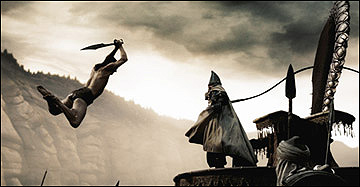
I have just been to see 300.

In case you have been sitting on a pillar in the desert for the last month, 300 is the movie adaptation of Frank Miller's graphic novel of the same name, in which a band of 300 Spartans die defending Greece against a Persian grand army.

Movie still, © Warner Bros.

Over the last month or so, reactions to the movie have been mixed. Some commentators loved the theatricality, the violence and the technology. (The entire movie was filmed in 60 days on blue and green screens in Montreal.) Others have deplored the historical inaccuracies. (There were other Greeks at Thermopylae besides the 300 Spartans, and the Persian Immortals probably weren't samurai-masked ninjas!) On reflection, the verdict of the Rotten Tomatoes web site seems fairly accurate: "a simple-minded but visually exciting experience".

Incidentally, historian Victor Davis Hanson's audio commentary can be found here.

Saturday, 31 March 2007

Emblems of Empire

Punta ad alette in ferro appartenente a uno dei portastendardi (Copyright MIBAC 2007).

Last year, I posted on the subject of the emperor Maxentius' imperial insignia.

Archaeology magazine has now joined the party, with an article quoting the views of excavation director Clementini Panella. But more exciting are the images, posted by Martin G Conde on Flickr, of the recent archaeological investigations conducted in the imperial fora of Rome (1995– 2007).

(I remain sceptical that the sceptre of a Roman emperor would look like this, though.)

Thursday, 1 February 2007

World Heritage Status (again)

I've been waiting with baited breath for February.

We were promised that the next development in the long-running World Heritage saga would be announced then. And, sure enough, events seem to be drawing to a close, with the news that UK Culture Secretary Tessa Jowell has formally submitted the Antonine Wall to UNESCO for consideration as a World Heritage Site.

The details posted on the World Heritage Tentative List reveal that the site would consist of a 60km corridor, 40m wide, running across the breadth of Central Scotland, from Old Kilpatrick in the west to Carriden in the east. (Exactly what that means in practical terms remains to be seen.)

Thursday, 25 January 2007

The Lost Legion

Some myths die hard.

It used to be thought that the Ninth Legion, the famous legio VIIII Hispana, had come to a sticky end in the wilds of Scotland. This particular legion, which dated back to the days of Augustus if not before, was probably in Britain from the start, participating in the invasion of AD 43. It certainly formed part of Agricola's army when he brought the Caledonian tribes to battle at Mons Graupius forty years later. The legion was engaged in construction work in its fortress at York (Roman Eburacum), some time in AD 108 (according to a stone inscription found there). But, thereafter, it seemed to disappear from the archaeological and historical record.

During the reign of Trajan (AD 98-114), the garrison of Britain stood at three legions. When Hadrian visited the province in AD 122 and planned the building of his well-known frontier wall, he brought a legion with him, the Sixth Victrix from Germany. Scholars assumed that the new legion was required to fill the gap left by some dreadful military disaster. Writing in 1936, Wilhelm Weber, the German biographer of Hadrian, confidently asserted that "the Britons had destroyed the legion IX Hispana in the camp of Eburacum".

In his monumental survey of the Roman legions, the German scholar Emil Ritterling had earlier noticed evidence of officers serving in the Ninth later in Hadrian's reign. So, when the British archaeologist Professor Sir Ian Richmond came to write on the subject, he was loathe to concede the annihilation of an entire legion, and posited instead a convoluted scenario whereby "the legion was cashiered following an ignominious defeat ... [but] some of its officers survived".

But already in the 1960s, Dutch archaeologists had found evidence of the Ninth Legion at the fortress of Nijmegen (Roman Noviomagus) in the Netherlands, dating from early in the reign of Hadrian. Most probably, there had been a troop rotation, a straight exchange of legions, Sixth Victrix replacing Ninth Hispana at York; sadly, there was no dreadful destruction of the Ninth at the hands of the Britons.

However, at some point, a new variation of the myth arose, and became enshrined in Rosemary Sutcliff's delightful Eagle of the Ninth. Generations of book-reading school children have grown up with the idea of the lost legion, an idea that recently resurfaced in an article on the ABS-CBN web site. There, the writer William Esposo listed world-class Scots literature and the many Scots inventors of the past, celebrating the Scottish character:

"At the peak of the expansion of the Roman Empire," he writes, "the Scots successfully resisted Roman conquest. Two Roman legions that were sent as an advance column to Scotland vanished without a trace – no bones, no armor, no signs of battle to suggest what became of them. The mighty Romans lost their nerve and zest for conquering Scotland and instead built Hadrian’s Wall; running 73 miles of open country to separate Romans from the barbarians."

Aye, some myths die hard.

(See also: Lost Legion Myth Lives On.)

Thursday, 4 January 2007

Frontier history

It's not every day that a new book about Antoninus Pius appears. In fact, the last one (by my reckoning) was 70 years ago.

Antonine wall bookNow, David Breeze, former Chief Inspector of Ancient Monuments in Scotland, has penned a short, 210-page, glossy account to accompany the preparation of the Antonine Wall as a UNESCO World Heritage Site.

Divided into 11 chapters, the first of which deals summarily with the emperor's life (pp. 1-18), Professor Breeze has followed a tried-and-tested formula for this kind of book. He explains the sources of evidence (ch. 2, pp. 19-34) and summarises the Roman army (ch. 3, pp. 35-43), before describing Antoninus' invasion of present-day Scotland (ch. 4, pp. 44-58). The Antonine Wall itself accounts for by far the longest chapter (ch. 5, pp. 59-102). (Incidentally, the Professor's arithmetic is not as good as 18th Century antiquary William Roy's. The latter, quoted on p. 59, observed that "the wall ... consists of three parts; a large ditch, a rampart, and a military way", but Professor Breeze writes (p.71) that "there were three essential linear elements: the rampart, the ditch, with the earth tipped out to the north. [So far, I make that two.] Behind the Wall ran a fourth feature, the Military Way." One, two, ... four?)

The rest of the book covers military deployment (ch. 6, pp. 103-128), everyday life (ch. 7, "Life on the Edge"!, pp. 129-143), the function of the wall (ch. 8, pp. 144-159), and its final abandonment (ch. 9, pp. 160-171). The post-Roman history of the wall is described in ch. 10 ("Grim's Dyke", pp. 172-180), and the Professor rounds off his book with some "Final thoughts" (ch. 11, pp. 181-188).

Details
The absence of footnotes (indeed, of referencing of any kind) often tantalises the reader. For example, many claims are made of the fort at Bearsden, claims which Professor Breeze (as the excavator in the 1970s) may be able to substantiate but which only an excavation report (hitherto unforthcoming) can settle. To say that "The number of barrack-blocks is often a guide to the size of the unit stationed at a particular fort" (p. 109) is perhaps self-evident. But why is it safe to assume that "the small barrack-blocks at Bearsden ... were probably occupied by cavalry"? We are earlier told that "the plan [of Bearsden] was clearly carefully designed" (p. 107), because it fits into a grid of 5 by 3 1/2 actus (the actus is 120 Roman feet square), but most of the interior is vacant and, on the contrary, gives the impression of having been surveyed by a one-eyed apprentice. "In some instances", we read, "the ditches continued across the front of the entrance without a gap", so should we perhaps envisage some kind of drawbridge? "At Bar Hill, unusually, an extra short ditch provided additional defence at the east gate" (p. 107), but the reconstruction sketch on p. 108 shows a similar feature at the south gate, too. When Professor Breeze writes in broad generalisations, is it safe to take them at face value? "On the Antonine Wall, the regimental bath-house was often inside the fort" (p. 109). Let's be clear: out of ten excavated forts, bath-houses were found at six, of which three were inside the fort and three outside in an annexe.

Occasionally, there is evidence of sloppy cutting-and-pasting. On p. 115, Professor Breeze refers to "the sewage at Bearsden". What sewage? On the next page, we read that "one of the most exciting discoveries at Bearsden arose from the biochemical analysis of the sterols surviving in the sewage". So, the picture is gradually building up. Finally, full clarity arrives on p. 120, where we learn that "the sewage from the latrine [aha -- a latrine was excavated at Bearsden!] drained into the fort ditches". Or, on p. 137, Professor Breeze writes that "Local or British gods were sometimes identified with the Roman gods: Camulus with Mars, Magusanus with Hercules, as we have seen." But we haven't seen ... yet. Not until p. 139 do we read about the "altar dedicated to Hercules Magusanus by a cavalryman" near the fort at Mumrills. There's a similar problem on p. 139, where we are told that "the historical importance of the dedication to Mercury found at Castlecary has already been noted". Certainly, "two altars ... to the west of Castlecary fort, one recording the erection of a shrine", were mentioned on p. 132, but the Professor doesn't divulge the full historical implication until p. 162! (And fails to mention that the altar is depicted as fig. 9.2 on p. 163, but the general lack of cross-referencing is another matter entirely.)

The book is admittedly short, and Professor Breeze does give the reader a flavour of the Antonine Wall and its history, as far as we understand it. But I can't help thinking that a splendid opportunity has been missed to present a new authoritative account for the twenty-first century, instead of this lightweight overview.