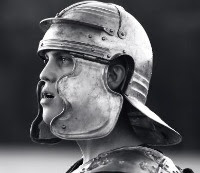
 The Romans are tweeting. Whatever next?
Apparently, Roman experts at Tullie House Museum in Carlisle have decided to post a daily message on Twitter, purporting to be one of the "thousands of Roman soldiers marching in to occupy Cumbria in the winter of 72/73 AD". They call it iTweetus.
What a marvellous idea. The name "is a play on words of the celebrated novel I, Claudius, written in the form of an autobiography of a real Roman Emperor, Claudius I". (It's a sad day when we have to have I, Claudius explained to us. And only people who don't need it explained would know that the emperor Claudius was technically "the first", since a second, more obscure emperor of the same name reigned over 200 years later.)
Unfortunately, iTweetus doesn't have the wit and wisdom of Robert Graves, which is surely needed to pull off a stunt like this.
Daily Diary of a Roman Soldier
Our Roman soldier, Marcus Julius Latinus, takes his name from a fragment of a writing tablet dredged from a latrine deposit at Roman Carlisle. Probably dumped there in around AD 103/5, when the first fort was demolished, it must have lain in the latrine for quite some time if it was delivered to iTweetus "in the winter of 72/73 AD". He really ought to have taken better care of his correspondence.
The whole enterprise is evidently intended to be educational: the kind of thing that our American friends call info-tainment. But, as the daily diary of a Roman soldier, it comes across as rather a contrivance. The museum's Keeper of Archaeology, Tim Padley, evidently hopes that primary school children will follow iTweetus (Westmorland Gazette report). Hence the casual mention of Marcus' height ("At 5ft10” I used to tower over my siblings, in the Roman army my height is standard. I strain to see past others in to the distance") or his age ("At 26, I am not a stranger to the daily routine of a Roman Legionary, being stationed in Deva in the second legion for the past two years"). But who would note such banalities in their wartime diary?
If the exercise is an educational one, quite apart from avoiding factual error ("Our legion, named ‘Aditrix Pia Fidelis’ is full of good, brave men." It was actually called the Second Adiutrix legion), this old emperor wishes that the Tullie House "Roman experts" would spend a little more time on their grammar (Note: a comma is not a conjunction). And it would be nice if they placed "AD" in its grammatically correct position, before the numeral ("I am Marcus Julius Latinus, a Roman soldier marching on Northern Britannia by order of Emperor Vespasian in the winter of 72AD")
In particular, this old emperor hopes that none of the Cumbrian school children are sharp enough to realise that their Roman friend is using a dating system that wasn't devised until the Sixth Century!

 You know that a story is important when the folks at National Geographic pick it up.
 This old emperor rarely ventures outside of Rome, and usually confines himself to the new lingua franca of English. But he couldn't ignore the publication of an exciting new study by German publisher
 As an outsider looking in -- I am, after all, a Roman emperor -- I am always bemused by the rampant Pictish nationalism on the internet. Whenever the subject of the Romans in Scotland arises, you can be sure that a Pictish sympathiser will pop up to berate us for our interest in an alien imperialist power. In any discussion of Caledonia, it seems that we should be rooting for the underdog, the downtrodden native.
 Second, the unfulfilled promises: "This programme follows Severus's trail from the magnificent remains at Lepcis Magna in the Libyan Desert, to the military hardware left by his campaign in Britain." I don't recall following any trail, but it was difficult to tell, with all the grainy, repetitive CGI scenes. I think we saw Leptis Magna. That was probably the place where
  It seems that there is a new book about Mons Graupius, the famous battle in Scotland where the Roman army of Agricola defeated the Caledonian tribes and brought Britain into the Roman empire.
 I was amazed to discover that Ephesus is not yet a World Heritage Site.