Thursday, 28 September 2006

Where's Roman Scotland?

I recently stumbled across a web page which purported to record the Roman ruins of Britain. Here's the accompanying map of Roman Britain!

Now, admittedly, as the sponsor of the Antonine Wall, I may be slightly biased. But I'm absolutely positive that the reach of Rome did not stop at the wall of my illustrious parent, Hadrian.

In fact, there were more than a few enclaves of Romans (admittedly, often barbarians in the pay of Rome, but supervised by fully accredited citizen officers) dotted around the Scottish lowlands for centuries.

But, most amusingly, if you click on any of the placenames on this map (in its original web location, of course), you are whisked off to a page about St. Albans, a town only marginally further north than Watford.

Roman ruins in Britain? I don't think so!

Tuesday, 19 September 2006

Happy birthday ...

... to me!

So, I'm officially 1,920 years old, and I don't feel a day over 40. Now, where are all these birthday greetings?!

Tuesday, 12 September 2006

The past is a foreign country ...

As L.P. Hartley astutely observed, they do things differently there.

I have long believed that the New Testament cannot be fully understood without an appreciation of the contemporary culture which produced it. Now, a new book by Mark Chancey of the Southern Methodist University, Texas, "challenges the conventional scholarly view that first-century Galilee was thoroughly Hellenized".

A recent review concludes that Chancey "succeeds in challenging the overstating of a Greek setting for first century Galilee". But this is old news. In 1993, E.P. Sanders published a study in the journal Theology Today, warning against those who "think that a few Greek inscriptions and the construction of a few Hellenistic buildings by Herod prove that Palestinian Jews were swamped by, and accepted whole-heartedly, the entirety of Greco-Roman culture". Jesus, it seems, lived in a very Jewish context, despite the proximity of Herod's Hellenistic kingdom and the looming presence of Rome.

Scholarship is often cyclical, as current ideas fall out of favour and new theories turn out to be old theories with a fresh coat of paint. But it is important that we have such debates, to clarify the meaning of history for each new generation.

Monday, 4 September 2006

Under siege

There aren't too many books about ancient siege warfare.

Besieged book jacket

But the Ancient & Medieval History Book Club is advertising a new one. "Through use of outstanding photographs and explanatory diagrams of siege warfare", says their blurb, "this expert study examines the techniques and weapons used during the period."

Interesting.

Monday, 7 August 2006

Busman's holiday

The imperial coffers have been a little light this year.

As it was vacation time, rather than a visit to the Bay of Naples (like any self-respecting emperor), I decided to treat the empress to an inspection of our northern dominions. In other words, a road trip to Aberdeenshire and the charming village of Oyne.

Reconstructed Roman camp
Roman Camp (reconstructed at Archaeolink).

Much to the empress's dismay, we discovered a Prehistory Park there, "with a central focus on education, participation and fun". However, the reality has not yet caught up with the intention. Indoors, there is really only a short film show to entertain visitors, but the fine weather allowed us to wander around the scenic park. There we found some rather unimpressive reconstructions of the sort that have become a feature of this blog.

Believe it or not, this photograph shows what the folks at Archaeolink think that a Roman temporary camp might have looked like. Admittedly, we were told that it was currently "under review". Nevertheless, the empress was unimpressed, and I shall have to think seriously about Naples next year.

Friday, 28 July 2006

Painting by numbers

It is well-known that the Romans painted their statuary.

And they may have had a penchant for bright colors. For example, it has been suggested that Hadrian's Wall was whitewashed, and the joints between the stone blocks picked out in red mortar. But I recently came across the ultimate in garish decor.

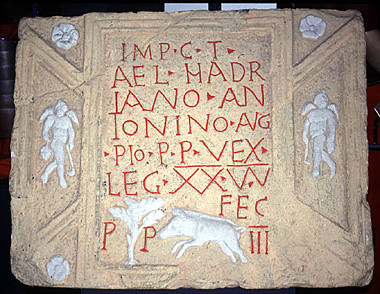
First, some background. The construction of the Forth & Clyde canal in the 1770s, broadly following the ancient line of the Antonine Wall, uncovered various decorative stone slabs now known as "Distance Slabs" (because their purpose was to record the various lengths of wall completed by the different legionary work gangs). Agricultural activity periodically turned up additional slabs, so that 20 are now known, each one different.

In 1865 (according to Lawrence Keppie's Roman Inscribed and Sculptured Stones in the Hunterian Museum), a splendid example was unearthed near Bearsden, and was sold for £2 to a Glasgow lawyer. When Glasgow University declined to purchase the slab from him, it was sold to the American consul and shipped to Chicago!

Photo: Barbara McManus, 1986
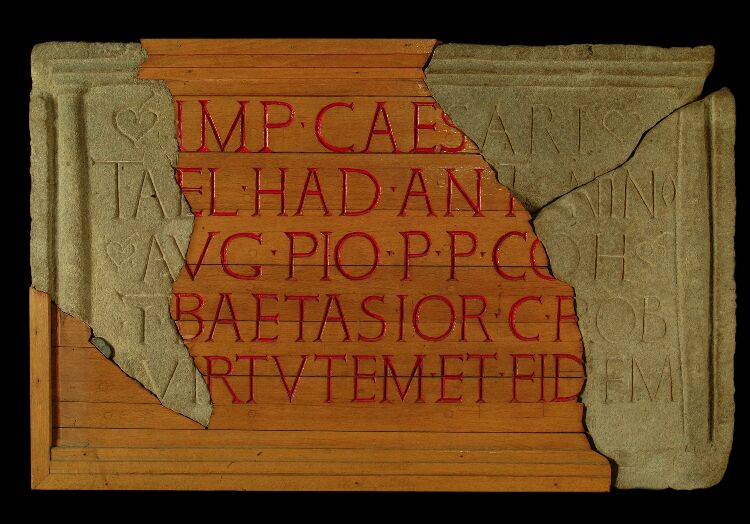
Cast of a Roman inscription (Grosvenor Museum, Chester)
Courtesy of the VRoma image gallery.

But, before you cry out for the rendition and repatriation of such an important antiquity, there's bad news. For the slab was lost, presumed destroyed, in the great fire of Chicago in 1871.

Thankfully, the great Hadrian's Wall scholar, John Collingwood Bruce, had the foresight to order several plaster casts of the slab before it departed; which brings us back to the subject of decor.

The ghastly purple slab illustrated here is, in fact, one of these plaster casts, deposited in the Grosvenor Museum at Chester. Whether the Romans would, in fact, have used this color scheme is unknown. My own preference is for the example still to be seen in the Hunterian Museum (Glasgow), which has been rendered in altogether more sobre tones.

Thursday, 20 July 2006

Ahhh, Bisotun ...

Continuing the theme of UNESCO's World Heritage Sites, it seems that Bisotun (more familiar to ancient historians as Behistun) has been included in the latest tranche.

This amazing rock-cut inscription, two-and-a-half thousand years old, has already been the subject of an exhaustive study by the indefatigable Jona Lendering on his excellent Livius web site.

The inscription at Behistun
Darius the Great's inscription at Behistun

Curiously, Darius apparently arranged for the relief to be cut 100m above the ground, so that nobody could tamper with the inscription. But, of course, it is entirely illegible from that distance!

When the Roman legions in Britain commemorated the building of the Antonine Wall with a series of splendid inscribed stones, we presume that they were at least displayed within sight of passers-by.

Monday, 10 July 2006

It's Magic

Magic map
OS Map of Temple of Boclair (courtesy of Magic).

I've discovered a little piece of Magic on the internet.

In a previous post, I drew attention to the Antonine Wall at Dobbies Garden Centre. Now, using the UK government's online rural GIS system (snappily entitled Multi Agency Geographic Information for the Countryside, or Magic), you can tap into large-scale Ordnance Survey mapping to analyse any geographical feature: say, the Antonine Wall at Dobbies Garden Centre!

Aerial view of Temple of Boclair
(courtesy of Microsoft's Windows Live Local)
.

One of my visitors pointed out that all he could see of our premier Roman national monument was "a bumffle in a field". But what an exciting bumfle!

Using the Magic data, you can see that the Antonine Wall (running from west to east) crosses the A879 and turns abruptly SE. Amazingly, on the aerial view (courtesy of the really, really useful Windows Live Local), you can actually see it as it turns and heads off the right-hand side of the photo.

Now don't tell me that's not impressive. Or, in fact, Magic!

Saturday, 1 July 2006

Dead language?

How ironic.

At a time when interest in the Romans in Scotland stands at an all-time high; when a glance at the television listings suggests a general fascination for things Roman; and when Scotland's Minister for Tourism, Culture and Sport has just endorsed the bid to grant the Antonine Wall World Heritage Status (continuing the theme from my previous post) ... How ironic that, at a time like this, Scotland's premier teacher training institution has chosen to "axe Latin".

Roman inscription from Bar Hill (RIB 2170)

Have the barbarians at the gates finally broken through? Are the philistines in charge? Of course, with even the teaching of History under threat in Scottish schools, the Culture Minister was careful to draw no links with the past, in her professed enthusiasm for res Romana. She simply stated that "This touch of Roman civilisation [sic!] in central Scotland [viz. the Antonine wall] is a reminder of the many European links of our country."

But what a pity if future generations of Scots, the descendants of David Hume and William Hunter, the heirs of Robert Adam and James Boswell, will not be equipped to decipher their rich Roman heritage.

Friday, 9 June 2006

Roman heritage

Back in 1972, UNESCO came up with the idea of World Heritage Sites, defined as properties having outstanding natural or cultural value.

Ecuador's Galapagos Islands were first on the list, and other early nominees included Auschwitz concentration camp, the Grand Canyon, and Australia's Great Barrier Reef.

In 1987, Hadrian's Wall, the frontier work named after my illustrious predecessor and adoptive father, Hadrian, achieved World Heritage status. The equally exciting Roman frontier remains in Germany, the so-called Obergermanisch-Rätischen Limes (ORL), were included in 2004. But what about my own frontier wall, virtually obliterated by the Forth & Clyde Canal and the small towns of Scotland's central belt? Surely it deserves recognition?

Antonine what?!
This sad sight, owned by Dobbies Garden Centre (Milngavie), is an "outdoor interpretation and display area" masquerading as a reconstruction of the Antonine Wall. The real thing, constructed around AD 142, must have been rather more impressive. It probably stood almost 3m high, and may have been surmounted by a timber palisade. In places, the ditch which fronted the wall was 12m wide and over 3m deep!

Happily, there has been a proposal to recognise the Antonine Wall as part of the new Frontiers of the Roman empire heritage site.

Fame at last!