Thursday, 14 February 2008

The Western Way of War

Ancient Warfare book

I have been reading a short book called Ancient Warfare. A Very Short Introduction, by Harry Sidebottom.

The jacket blurb claims that the author "provides a fresh approach to all aspects of ancient warfare, from the philosophy surrounding it, to the strategy and the technical skills needed to fight". All aspects of ancient warfare?! This is a big claim to make for a 165-page book. And one which (surprise, surprise) is not entirely justified.

As far as supporting material goes, there are five nicely-produced maps; admittedly, they are not really tied into the text and I don't recall consulting them as I read, but so many history books appear without maps that their presence here seems to be "a good thing". And there is an interesting selection of black-and-white illustrations, including 8 scenes from the Column of Marcus Aurelius (a welcome departure from the usual Trajan's Column). Also, the "Further reading" section runs to 28 pages, so it is nothing if not comprehensive.

But what about the content? The title promises an "Introduction" to ancient warfare ... but is it? I certainly found it to be an interesting read. But does it really discuss "all aspects of ancient warfare"? There is a chapter on "Thinking with war", where Dr Sidebottom emphasizes that war was an all-pervasive constant in the ancient world, and a chapter on "Thinking about war", where he sketches the thoughts of ancient philosophers on the subject. There is a chapter about "Strategy", which includes a brief critique of Edward Luttwak's 1976 book (The Grand Strategy of the Roman Empire), and a chapter about "Fighting", where he considers the battle experience of a hoplite, a phalangite, a legionary, and cavalry, touching upon the old chestnut about whether "only a few fight?" But, in terms of the overarching theme, what Dr Sidebottom has written is actually an extended critique of the opening battle scene from Gladiator. On p.1, we read:

"The film Gladiator opens with an epic battle in the forests of Germany. On one side are the Romans, in disciplined units with uniform equipment. They wait in full view, in silence, and prepare their relatively high-technology weapons. Their watchwords are 'strength and honour'. ... In combat they help each other, and display courage. On the other side are the barbarians. They have no units, and, clad in furs, no uniformity. Some carry stolen Roman shields, but they lack the catapults that represent the top level of military technology. Initially they conceal their force in the woods. Surging backwards and forwards, each man clashes his weapons on his shield, and utters wild shouts. ... They rush into combat as a mob, and fight as ferocious individuals. On one side is civilisation, on the other savagery."

It is Dr Sidebottom's thesis that Ridley Scott's Romans represent the accepted picture of The Western Way of War, and he is at pains to demonstrate that this is incorrect. Whether or not this cinematic construct actually does represent our view of western warfare must remain a moot point. In my opinion, Dr Sidebottom has simply set up a straw man which is easily knocked down.

Friday, 1 February 2008

Croatian Limes

An emperor should never admit when he's wrong. But it seems that my knowledge of the Roman frontier (or "limes") along the middle Danube was deficient.

Map of CroatiaIn an earlier post, I suggested that the only Roman military remains in Croatia were the pre-Flavian legionary fortresses at Burnum (near Kistanje) and Tilurium (Gardun). Located in the Adriatic province of Dalmatia, in the far west of Croatia, they are almost 200 miles from the imperial frontier.

In my own defence, I can only point out that, besides a one-year governorship of Asia in AD 135, I have never set foot out of Italy, and have no military experience whatsoever! Nor is geography my strongest subject. So it is perhaps understandable, if not entirely forgivable, that I was unaware of one important fact: namely, that 188 km of the Croatian border in the east is marked by the river Danube (as an anonymous correspondent kindly informed me).

For much of its course, the Danube marks the northern limit of the Roman empire, flowing east through Austria and Hungary to the great bend above Budapest, whereupon it turns south, eventually entering Croatian territory between the rivers Drava and Sava, before turning east again at Belgrade and (having traversed a series of spectacular gorges) wending its way through Serbia, Romania, and Bulgaria to the Black Sea coast.

This sector of Roman frontier is apparently awaiting recognition as a World Heritage Site. Forts are known at Batina Skrela (Roman Ad militares), Osijek (Mursa), Dalj (Teutoburgium), Sotin (Cornacum), and Ilok (Cuccium), but the remains have yet to be developed for public viewing. Let us hope that World Heritage Status will provide the impetus.

Monday, 28 January 2008

Knock, knock!

It is fitting that the first (albeit belated) post of the New Year should be about doors.

Roman Door (c) Pre-Construct Archaeology

The Latin word for door, ianua, gives us our word "janitor", traditionally the door-keeper. So the Roman god Janus (deriving his name from ianua) was the patron, not only of doors and gateways, but of new beginnings. Literally two-faced, he looked back into the old year and forwards into the new.

The accompanying image is the wonderfully complete example of a Roman door excavated in London at the Drapers Gardens site by PCA.

Monday, 29 October 2007

The Rewards of Service

A splendid new Latin inscription was discovered this week at Carberry. The find spot is near the Roman fort of Inveresk, which lay on the south coast of the Firth of Forth forming part of the Antonine frontier, and the new inscription may well be contemporary.

Carberry tombstoneThe find is a tombstone belonging to Crescens, a Roman cavalryman, and would originally have sported an ostentatious depiction of the man in action. This part probably broke off when the stone fell over, and perhaps awaits discovery in the earth nearby. The part that remains is the short curriculum vitae appended by Crescens' heir, who erected the stone in his memory.

"To the shades of the departed and of Crescens, cavalryman of the ala Sebosiana, one-time member of the governor's horseguard, who served for 15 years. His heir set this up."

It was common for the men of the auxiliary regiments, both horse and foot, to be selected for the provincial governor's bodyguard, the equites and pedites singulares. Professor Michael Speidel, the pre-eminent scholar of Roman guard units, thought that each province's guards were organised into a mixed numerus singularium ("unit of guards"), but this tombstone specifically states that Crescens was ex numero equitum singularium ("previously in the unit of horse guards"). In 1978, Professor Speidel noted with regret that "no direct evidence for singulares has come to light in Britain yet". Today, he should be delighted.

Saturday, 13 October 2007

Wandering frontiers

Antonine Wall Management Plan, p. 15

This one should really have been called "To boldly go ...", I think.

Browsing through the new Antonine Wall Management Plan, I discovered a handy list of the modern countries through which the Roman frontier runs (extract from p. 15 pictured here).

"Remains of Roman frontier installations can be seen", it says, "in the United Kingdom, the Netherlands, Belgium, Germany, Switzerland, ..." So far, so good. We appear to be running from north to south down the Rhine frontier (but Belgium?!).

"... Austria, Slovakia, Hungary, Slovenia ..." Okay, we've turned east to run along the Danube frontier. But Slovenia?! That's not even in sequence: we appear to have leapt back west, to a country well behind the frontier and, more importantly, not noted for its Roman remains. "... Slovakia, ..." Right, Slovakia again: back to our original list? "... Croatia, Serbia, Slovenia, ..." Now this is getting silly. Croatia was at least going in the right direction again, and there were legions based there, though to classify their remains as frontier installations might be stretching it a bit. And Slovenia, again!

"... Bulgaria, and Romania." Phew! It seems that the Roman frontier meandered further than I thought.

Saturday, 29 September 2007

To boldly go ...

At last! The Antonine Wall -- my wall! -- has been confirmed as the UK's 2008 nomination for World Heritage Site status. And we have much to look forward to.

Management Plan, p. 48Historic Scotland's Management Plan (extract from p. 48 pictured here) promises a Frontiers of the Roman Empire web site! With the linking of national and local databases! (Databases of what?) And new, improved documentation on Roman frontiers in Europe! (On the web site?) And an exhibition on Roman frontiers! (On the web site?)

But the funding was awarded two years ago. So where is this web site? I think we should be told.

Monday, 6 August 2007

The pride of the Roman cavalry

I am an old, grumpy emperor and, often when I read a new book, I am easily irritated.

Chiefly, I dislike badly written books. I realise that different writers have different styles, but there's no excuse for poor grammar. Here's an example: "The pride of the Roman cavalry was the horsemen of the alae." The subject of this sentence is plural -- there were lots of horsemen in the alae -- so the verb must be plural, too. The pride of the Roman cavalry were the horsemen of the alae. See? That's a lot better. (By the way, alae is just a technical term for the Roman cavalry regiments.)

I also dislike inaccuracy, which can take many forms from 'typos' to outright factual errors. For example, the Latin word tironis does not mean "recruits"; Roman socks were not called undones; and the Latin plural of lancea (a lance) is not lancae. (Before you reach for your Wheelock, the correct answers are: tirones, udones, and lanceae.)

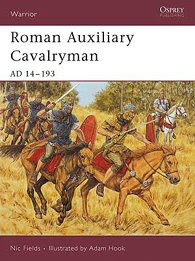
Roman Auxiliary Cavalryman, (c) Osprey Publishing

Trustworthy?

All of these mistakes were extracted from the latest book to land on my desk: Roman Auxiliary Cavalryman AD 14-193. (That's the title on the cover; on p.1, the inside title-page, it's called "Roman Auxiliary Cavalry". At least the author's name is spelled correctly.)

The Latin mistakes I'm willing to classify as simple gaffes (although I am suspicious of their recurrence, along with others, in the book's glossary). Another example -- the Latin document known as De munitionibus castrorum ("About fortifying camps") is repeatedly cited as De muntionibus castrorum -- might just be a publisher's typo. But there are more fundamental errors that should perhaps have been nagging at the back of the author's mind as he wrote them.

As an exemplar for a typical cavalry regiment name, he gives us the ala Gallorum et Thracum Classiana invicta bis torquata civium Romanorum. He tells us that it was formed in AD 21. (How does he know?) He tells us that its first commander was a Gallic nobleman called Classicianus! (If its title "Classiana" really does indicate the founder, then his name was Classius, not Classicianus!) He tells us that it transferred from Britain to Germany in AD 122. (True, we have no evidence of it in Britain after AD 122, but that's not proof that it left the province in that year.) And so it goes on.

Review

If I were writing a book review, I'd tell you the basic breakdown of the book. So, after a brief "Introduction", there are short sections on

  • "Recruitment" : Table 1 on p.7, labelled "Cavalry recruitment", details "Numbers" totalling 39,500 from 11 provincial areas, but doesn't really explain what this represents (Recruits in a year, maybe?) ;
  • "Organization" : if a cavalry "troop" (turma) is consistently given as 30 men + 2 officers, why isn't the infantry century (centuria) given as 80 men + 3 officers?;
  • "Equipment and Appearance" : we are told the weight of a pair of boots (!) but not the weight of a helmet, which seems slightly more important;
  • "Training and Exercises" : I know it's nit-picking, but surely Xenophon's Greek text is called Peri hippikes, not Peri Hippikis (and Arrian's Techne taktike has been mangled by the typesetter);
  • Conditions of Service : short sections on pay, rewards, and diet;
  • Military Life : in the military calendar of celebrations, the "festivals associated with the leading deities and members of the imperial family" were not called dies imperii! ;
  • On Campaign : short sections on rations, fodder, before battle, and during battle ; and
  • After Service : it seems odd that honourable discharge was granted "only after a thorough medical examination" !

Easily irritated?

I think my enjoyment of a book is inversely related to the number of times I have to mentally correct the text, like a belated proof-reader. I'd like to know more about Roman cavalry, but there must be a less stressful way to do it!

Saturday, 16 June 2007

Arthur iterum

In a previous post, I drew attention to the bizarre theory that the King Arthur of legend was actually a 2nd century Roman officer named Lucius Artorius Castus.

An anonymous visitor to that post recently asked, "Is it true that there are common elements, not only between the names but details of Artorius's life and Arthur's?" The short answer is: No, it's not true. But I know you'd prefer the long answer.

The folklorist and doyenne of Arthurian mythology, Linda Malcor, has published an article in The Heroic Age (a web-based "Journal of Early Medieval Northwestern Europe") entitled Lucius Artorius Castus: The Battles in Britain. Here, she alleges that "certain details of Castus's military career in Britain correspond to details in the traditional biography of the legendary King Arthur". It is worth taking a closer look at those alleged parallels.

Artorius and the Sarmatians?

Roman cavalry near Ribchester / (c) Lancashire County Council

Dr Malcor writes that "Arthur's men were armored cavalry who fought with swords, lances and shields; while in Britain, Castus commanded Sarmatian numerii [sic] from fort Bremetennacum". She claims that this proves that they were one and the same man. But I have already demolished the Sarmatian link. The facts are these: in AD 175, the emperor Marcus Aurelius (of Gladiator fame) transported 5,500 Sarmatian horsemen to Britain. For 65 years, they disappeared from history, and were perhaps dispersed across the province to reinforce other garrisons; but around AD 240 a numerus equitum Sarmatarum (or "unit of Sarmatian horse") made their presence known at the fort of Ribchester, ancient Bremetennacum (pictured). It was the opinion of the eminent archaeologist Professor Sir Ian Richmond that Sarmatian tribesmen had settled in the area, but definite proof is lacking.

Of course, Dr Malcor is quite wrong to claim that "Castus commanded Sarmatian numerii". In fact, Artorius Castus held a succession of legionary centurionates, culminating in the post of praefectus legionis VI Victricis ("prefect of the Victorious Sixth Legion"), after which he commanded a battle group in northern France drawn from the legions and cavalry regiments of Britain. At no stage was he a cavalry prefect (which would have required an entirely different career path).

Artorius in Northern England?

British Museum manuscript Harley 3859 (folio 187A)

Dr Malcor's main argument states that "the second-century dux Lucius Artorius Castus most likely fought a series of battles that does happen to fit the battle list [of King Arthur]". But again, she is quite wrong. (This battle list appears in an early medieval manuscript [pictured] of the Historia Brittonum or "History of the Britons" usually attributed to Nennius; it constitutes a series of 12 vague locations for Arthurian battles, apparently translated from Old Welsh into Latin.) Remember: all we know about Artorius Castus' time in Britain is that he was attached to the VIth Legion at York, probably for a year, and led a battle group across the Channel adversus Armoricanos, "against the Armoricans".

However, Dr Malcor embarks on the narrative of a "Caledonian invasion", which should be classified as historical fiction: "In 183 the Caledonii breached the Antonine Wall and flooded south", she writes; "the Roman forts -Trimontium, Habitancum, Cappuck, and Bremenium - collapsed along the road that became known as Dere Street", and the invaders "attacked Eboracum (York), where they killed a Roman general".

The facts, ma'am.

Let's consider the facts: the Roman historian Cassius Dio records that, during the reign of Commodus, "the tribes in the island crossed the wall that separated them from the Roman forts, doing much damage and killing a general and the troops he had with him; Commodus in alarm sent Ulpius Marcellus against them". Not Artorius Castus, but Ulpius Marcellus, the senatorial governor who is known to have been in the province by 23 March AD 178. The Romans had evacuated the Antonine Wall almost twenty years earlier, along with the Scottish forts listed by Dr Malcor, so the wall that the barbarians crossed must be Hadrian's Wall. But the tribes are not identified (so we don't know if they were "Caledonian"), and there is no reason to suppose that the Roman general was killed in York.

However, Dr Malcor is not constrained by the evidence. "By the time Marcellus arrived," she continues, "the fighting was no longer south of Hadrian's Wall but in southern Scotland, north of the Forth-Clyde Isthmus, and he ordered the successful commander to pursue a punitive campaign against the invaders, that is, if possible, to exterminate them all." This is pure fantasy. Firstly, it seems that Marcellus was already in the province; he probably moved swiftly to the northern frontier from the provincial capital at London, gathering troops as he went. Secondly, the resulting warfare may well have taken place in southern Scotland (which is south of the Forth-Clyde isthmus!), but Cassius Dio doesn't tell us. And thirdly, the "successful commander" was Marcellus himself.

The fantasy.

In her summing up, Dr Malcor's theory can be seen to have no basis in fact. "In 185 Lucius Artorius Castus was promoted to the rank of dux," -- actually, we don't know when he was promoted as the inscription remains undated -- "a position that very few equestrians held prior to the time of Diocletian" -- actually, during the Principate (the period prior to Diocletian), dux was a temporary command or function, not a rank, and was invented to give non-senators the temporary authority of a senatorial legate -- "... the pattern of destruction from 183 to 185, attested by archaeological finds suggests that Castus was the victorious commander who reversed the disaster for the Romans," -- no, we've already seen that it was Ulpius Marcellus who was sent to deal with the problem -- "and the troops he used were the Sarmatian cavalry of Bremetennacum". Hold on, there! Where did that last bit suddenly come from? Nobody, but nobody, has mentioned anything about Sarmatian cavalry! (See Artorius and the Sarmatians?, above.)

It seems that Dr Malcor has erected a teetering edifice of half-truths: "Castus's campaign, like Arthur's, consolidated Britain following a period of infighting (in Castus's case, this involved the mutinee of the VI Victrix)" -- mutiny?! -- "the victorious campaign conducted by Castus with the Sarmatians of Bremetennacum (Ribchester) preserved Britain for the Romans" -- again with the Sarmatians! -- "and certainly sky-rocketed Castus's career into realms rarely seen by an equestrian of his day."

Remember one thing: the career of Lucius Artorius Castus remains undated, so he may not even have been in Britain in AD 180. And if he had any connection whatsoever with Sarmatians, he certainly didn't tell anyone about it!

Saturday, 9 June 2007

A soldier's diploma

Roman DiplomaHow bizarre!

Utah County's Deseret News web site reports that the Harold B. Lee Library (Brigham Young University) has on display "replicas of two 2nd-century, Roman, bronze metal plates that date back to A.D. 109". They are important, it seems, because they are "relevant to the Book of Mormon plates". BYU professor of law John W. Welch is quoted as saying that "This may be the best example of ancient writing on metal plates anywhere in the world".

Let me point out, firstly, that the university library also has the originals, and secondly, that they are examples of a very widespread phenomenon: the Roman auxiliary soldier's diploma, or guarantee of citizenship.

The BYU artefact is known to epigraphers (or students of inscriptions) as RMD III, 148. (It was published in 1993 by the late Margaret Roxan in her Roman Military Diplomas, volume 3: hence, "RMD III".) There, she noted that it had been issued on October 14, AD 109, to one Marcus Herennius Polymita, who had probably been recruited to his unit, cohors I Montanorum, in AD 84. The diploma was discovered in the Roman province of Moesia Superior, some 30km from the legionary base at Viminacium.

So what has all this got to do with the Book of Mormon?!

Saturday, 19 May 2007

Not-so-great Alexander?

© National Geographic News

According to National Geographic News, Alexander may not have been so Great after all. New research has shown that changing sea levels and shifting sands helped him to conquer the island city of Tyre in 332 B.C.

Scholars have always wondered at the amazing feat of engineering which Alexander's army accomplished in constructing a 740m-long causeway to connect Tyre with the mainland. But now, researchers have found evidence to suggest that the waters were probably only 1-2m deep!

The building of the 60m-wide causeway still ranks as a major undertaking.

(A view of how the causeway might have looked can be seen on the cover of this Ancient Siege Warfare book.)