Thursday, 20 July 2006

Ahhh, Bisotun ...

Continuing the theme of UNESCO's World Heritage Sites, it seems that Bisotun (more familiar to ancient historians as Behistun) has been included in the latest tranche.

This amazing rock-cut inscription, two-and-a-half thousand years old, has already been the subject of an exhaustive study by the indefatigable Jona Lendering on his excellent Livius web site.

The inscription at Behistun
Darius the Great's inscription at Behistun

Curiously, Darius apparently arranged for the relief to be cut 100m above the ground, so that nobody could tamper with the inscription. But, of course, it is entirely illegible from that distance!

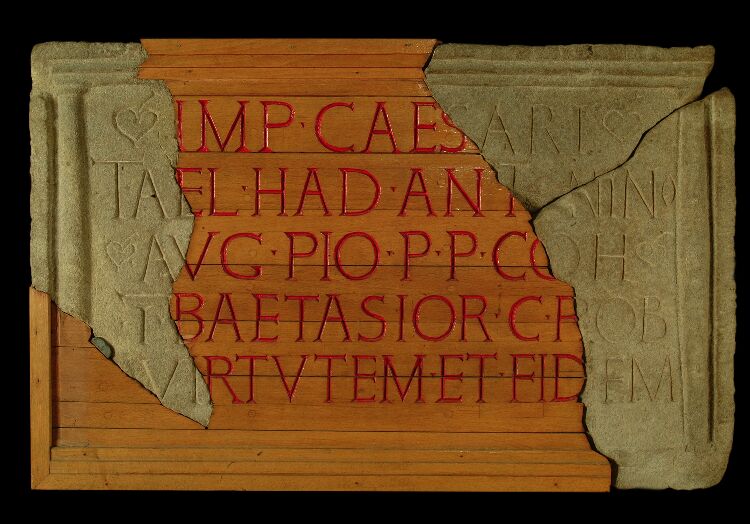
When the Roman legions in Britain commemorated the building of the Antonine Wall with a series of splendid inscribed stones, we presume that they were at least displayed within sight of passers-by.

Monday, 10 July 2006

It's Magic

Magic map
OS Map of Temple of Boclair (courtesy of Magic).

I've discovered a little piece of Magic on the internet.

In a previous post, I drew attention to the Antonine Wall at Dobbies Garden Centre. Now, using the UK government's online rural GIS system (snappily entitled Multi Agency Geographic Information for the Countryside, or Magic), you can tap into large-scale Ordnance Survey mapping to analyse any geographical feature: say, the Antonine Wall at Dobbies Garden Centre!

Aerial view of Temple of Boclair
(courtesy of Microsoft's Windows Live Local)
.

One of my visitors pointed out that all he could see of our premier Roman national monument was "a bumffle in a field". But what an exciting bumfle!

Using the Magic data, you can see that the Antonine Wall (running from west to east) crosses the A879 and turns abruptly SE. Amazingly, on the aerial view (courtesy of the really, really useful Windows Live Local), you can actually see it as it turns and heads off the right-hand side of the photo.

Now don't tell me that's not impressive. Or, in fact, Magic!

Saturday, 1 July 2006

Dead language?

How ironic.

At a time when interest in the Romans in Scotland stands at an all-time high; when a glance at the television listings suggests a general fascination for things Roman; and when Scotland's Minister for Tourism, Culture and Sport has just endorsed the bid to grant the Antonine Wall World Heritage Status (continuing the theme from my previous post) ... How ironic that, at a time like this, Scotland's premier teacher training institution has chosen to "axe Latin".

Roman inscription from Bar Hill (RIB 2170)

Have the barbarians at the gates finally broken through? Are the philistines in charge? Of course, with even the teaching of History under threat in Scottish schools, the Culture Minister was careful to draw no links with the past, in her professed enthusiasm for res Romana. She simply stated that "This touch of Roman civilisation [sic!] in central Scotland [viz. the Antonine wall] is a reminder of the many European links of our country."

But what a pity if future generations of Scots, the descendants of David Hume and William Hunter, the heirs of Robert Adam and James Boswell, will not be equipped to decipher their rich Roman heritage.

Friday, 9 June 2006

Roman heritage

Back in 1972, UNESCO came up with the idea of World Heritage Sites, defined as properties having outstanding natural or cultural value.

Ecuador's Galapagos Islands were first on the list, and other early nominees included Auschwitz concentration camp, the Grand Canyon, and Australia's Great Barrier Reef.

In 1987, Hadrian's Wall, the frontier work named after my illustrious predecessor and adoptive father, Hadrian, achieved World Heritage status. The equally exciting Roman frontier remains in Germany, the so-called Obergermanisch-Rätischen Limes (ORL), were included in 2004. But what about my own frontier wall, virtually obliterated by the Forth & Clyde Canal and the small towns of Scotland's central belt? Surely it deserves recognition?

Antonine what?!
This sad sight, owned by Dobbies Garden Centre (Milngavie), is an "outdoor interpretation and display area" masquerading as a reconstruction of the Antonine Wall. The real thing, constructed around AD 142, must have been rather more impressive. It probably stood almost 3m high, and may have been surmounted by a timber palisade. In places, the ditch which fronted the wall was 12m wide and over 3m deep!

Happily, there has been a proposal to recognise the Antonine Wall as part of the new Frontiers of the Roman empire heritage site.

Fame at last!

Thursday, 1 June 2006

All you ever wanted to know about Ancient Greek Fortifications?

I recently acquired a copy of Ancient Greek Fortifications 500-300 BC, by Nic Fields, "a freelance author and researcher based in south-west France" (lucky Dr Fields). "This book", says the blurb, "details the construction and ongoing development of the defences that protected some of the most illustrious sites in Greece during the most famous period of its history."

I beg to differ.

The already-short book (it has 64 pages, and copious illustrations, many full-page) begins with a three-page "Chronology of major events". The only problem is that there's almost no sign of "the construction and ongoing development" of Greek fortifications here. Out of 132 date entries, I found only 21 that were relevant, chiefly through mentioning a siege or a capture (e.g., "332 BC sieges of Tyre, Gaza"), and only three that actually recorded the construction of a fortification (Athens twice, Kassandreia, and Thessalonika); none mentioned ongoing development.
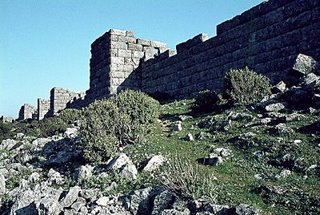
Gyphtokastro (Attica, Greece)


The fortress of Gyphtokastro (Attica, Greece) guards the Kaza pass over the Mount Parnitha range, which was the main route from Athens to Thebes. The north wall stands to its original height of about 6m; the towers survive to about 8m, and may originally have been closer to 10m. (Each course of masonry is about 70cm high, and the average stone block is 2m long!)

A chapter on "Building Methods" is a good start, but Dr Fields spouts technical terms without explaining them: "ashlar blocks", anyone? Okay, I will grant that Wikipedia comes to the rescue for this one, but what about "socle"? The one-page Glossary at the back (p.63) isn't much help; it contains only 15 terms – like "Palisade: Barrier constructed from wooden stakes, which are positioned vertically in the ground" – and uses only half the page. (A socle, by the way, is a stone-built plinth designed to provide a solid foundation for a mud-brick wall, and could stand a metre or so high.)

The main chapter, entitled "Fortifications", is simply a description of four different sites (Athens, Gyphtokastro, Mantineia, and Messene), with briefer comments on 'Other fortifications' (Aigosthena, Eleusis, Eretria, Phyle, Sounion). The sites were perhaps selected to match Dr Fields' photo collection, and that's no bad thing. But we get no sense of the promised "ongoing development" of fortifications.

The third chapter, "Nature of conflict and society", discusses infantry combat and the hoplite phalanx at great length, leaving a single page on "siegecraft" (half of p.50 and half of p.51) and a half page (p.52) on "non-torsion catapult". The mention of catapults is interesting, in the light of the tables that pop up at random intervals in the text. On p.20, there's a table of "Calibrations of bolts for bolt-shooter", with no apparent tie-in to the text. (The index confirms that this is the only mention of "bolt-shooters and bolts" in the book.) Here, the reader will learn that "1-cubit" equates to "1 cubit (pechys - 462.4mm (18.21in.)", though what he or she is supposed to do with that knowledge is unclear. The catapult, invented in 399 BC, just squeezes in at the tail-end of Dr Fields' time-scale (500-300 BC), but doesn't really figure in the text. Several photo captions take it for granted that towers were for artillery and the painting on p.39 of a tower shows catapults inside. (Though, without bows or springs, they wouldn't have been very effective!)

All in all, I'm left with the feeling that a great opportunity has been missed. The average reader will surely be left bemused by the whole subject. On p.52, there's a table of "Engines of war", listing seven dates and seven towns. The book, I think, can be summed up by one of these seven entries, which hints at some action at Oinoe in 431 BC ("Thucydides 2.18.1 - mechanai, possibly battering rams"); a glance at the index shows that Oinoe appears on p.28, where we read that "the fortified Attic deme of Oinoe (Myoupolis) had been walled by the start of the Peloponnesian War at the latest (Thucydides 2.18.2)"; and, if we check the all-important Chronology, we find "431 BC ...", no mention of Oinoe!

So, is this book about "the construction and ongoing development of the defences that protected some of the most illustrious sites in Greece"? I don't think so.

Wednesday, 31 May 2006

A desirable property

We recently took advantage of the unseasonably fine Scottish weather to visit Kenmore. There we saw a splendid example of a crannog, or ancient loch dwelling, reconstructed in situ.

Loch Tay crannog

Apparently, the name (somewhat unimaginatively) means "timber structure", a fact which is missing from both Wikipedia and the excellent Time Team site.

The setting is very dramatic, and reminds us of the Iron Age penchant for conspicuous deployment of labour and consumption of resources.

Wednesday, 17 May 2006

Roman Legions ... in color!

A new book is available in specialist bookstores near you.

Roman Legionary Fortresses
The jolly colorful cover conceals a wealth of information, fascinating to anyone who has ever wondered, "What did they do in Roman legionary fortresses, anyway?" or "How many legions did Antoninus Pius actually have?"

It has already received favorable commentary from those hard-hitting critics at Roman Army Talk. So, what's stopping you? Get straight out to a well-stocked Ancient History/ Humanities/ Archaeology newsstand near you, and start browsing.

You know it makes sense.

Thursday, 16 March 2006

Martial's blog

I recently came across a rather interesting blog, written by Mark Keith, a high school Latin teacher in America. The day I discovered his blog, Mark was describing his classroom. But in an earlier post, he quoted a snippet of the Roman poet Martial (in the original Latin, of course).

Feeling lazy, I launched an internet search for a translation, ... and found nothing. First port of call was the Perseus Project, but in its list of 489 ancient texts, Cornelius Nepos follows straight after Lysias, omitting Marcus Valerius Martialis entirely. The Latin text is certainly available in The Latin Library, but why are there no on-line translations? Surely not because of Martial's reputation for scurrilous (not to say disgusting) verse?

Well ... maybe so. The Artful Dodge magazine presents, on its web site, three of Martial's Epigrams, with an introduction by translator Joseph Salemi, where he reveals that not one of the 54 magazines he approached would publish his translations. This, he attributes to "our neurotic fear of offending anyone or any group".

But today, serendipity brought the Martialis blog to my browser. Beginning in June 2004, the author ("Nick") intended to translate one of Martial's poems every day. Although he ran out of steam last year, having managed 287 poems from Books I-III, there, in all its tiny glory, was Epigram I.61, the snippet quoted by Mark Keith: "Verona loves the syllables of the learned poet, Mantua is fortunate in Maro, ... as for you, Licinianus, our Bilbilis will boast of you, and will not be silent about me".


Postscript: If there are any Latin teachers looking for Advanced Higher tasks to set, how about continuing the on-line translation of Martial? I'm sure the pupils would enjoy it!

Sunday, 12 March 2006

In search of a search engine

I have a history of championing the underdog. Or, more accurately, boycotting market leaders, out of sheer stubbornness.

For example, I avoided Microsoft products for a long time. In truth, it wasn't difficult in 1991, when I was using WordPerfect (versions 5.1/6.0), Lotus 1-2-3 and dBase III+ (with Clipper). As the WWW took off, I again sidestepped the Microsoft product as a point of principle, moving from Netscape Navigator to the more W3C-friendly Opera browser. Of course, the irony is that, since 1992, I've been using various flavours of Microsoft Windows, when I should really have embraced Linux.

My latest ploy, as a fully paid-up Microsoft Office-user (the shame!), is to avoid Google. Actually, I have always been an AltaVista user, so I rarely feel the urge to "Google". But I used to occasionally use an "ancient world" specialist search engine called Argos. Sadly, when I tried to access it last week, I found that it had long since ceased to function.


Click to see bigger version of this image

Withdrawal of service notice for the Argos ancient world search engine


So I am now on the look-out for a suitable alternative. Any suggestions will be gratefully received.

Wednesday, 8 March 2006

Drink deep, or taste not the Pierian spring

I recently came across a book entitled Warfare in the Ancient World by Brian Todd Carey. According to the jacket blurb, Professor Carey is a history lecturer in the American Public University System and vice-president of the Rocky Mountain World History Association. He tells us that the book is intended to accompany his undergraduate course at the American Military University: as he puts it, "unable to find a suitable text, I decided to write my own".


How peculiar. Isn't it school children who require text books? Shouldn't undergraduates be encouraged to read widely? "A little learning ...", as Alexander Pope said. Unfortunately, not even the author seems to have read widely. There are, on average, three end-notes per page (429 notes in all, spread over 149 pages). Something like 10% refer to primary sources: Thucydides, Polybius, Caesar - the actual descriptions of events surviving from antiquity. The rest borrow extensively from a core of modern American popular works: Arther Ferrill's The Origins of War: from the stone age to Alexander the Great; Richard Gabriel & Karen Metz's From Sumer to Rome: The military capabilities of ancient armies; Richard Gabriel & Donald Boose, Jr.'s The Great Battles of Antiquity: a strategic and tactical guide to great battles that shaped the development of war (phew!). He has consulted a similarly small cadre of modern British works, too: Warfare in the Ancient World, edited by General Sir John Hackett; John Warry's Warfare in the Classical World; and (of course) Peter Connolly's Greece and Rome at War.


But (and herein lies the problem) Professor Carey appears not only to have consulted, but to have borrowed heavily, while excluding more specialist works. How, for example, can anyone discuss Gaugamela, the great set-piece battle at the centre of Oliver Stone's recent movie, without referring to Eric Marsden's classic 1964 monograph, The Campaign of Gaugamela?


Academic disciplines like archaeology and ancient history are built on the study of the primary sources: the actual remains, supplemented by a reading of contemporary or near-contemporary textual accounts. For ancient warfare, we think of works like Victor Hanson's The Western Way of War, where the index of ancient citations runs to 11 pages; or Adrian Goldsworthy's The Roman army at War and Hugh Elton's Warfare in Roman Europe, AD 350-425, each based on the respective author's PhD research. To give Professor Carey his due, these works certainly appear in his bibliography, but I wonder whether he has read them.


For example, in the chapter entitled "The Roman Empire at War", we are informed that "the role of Roman cavalry on the battlefield increased because of prolonged contacts with cavalry-based tactical systems in the east" (p. 123). What does this mean? That the emperor Augustus suddenly discovered how useful cavalry could be? Isn't Professor Carey aware, for example, of the frequent cavalry skirmishes during Caesar's African war of 48-46 BC? Or does he mean to imply that the characteristic infantry legions were supplanted by the forerunners of the medieval knight? Elton, for one, has estimated that "at Strasbourg in 357 [the future emperor] Julian had 10,000 infantry and 3,000 cavalry". Very similar numbers are found in Arrian's array of AD 132, in his plan to repulse an invasion of the Alans. So, where's the "increased role"?


Also, shouldn't we mistrust any military historian who cannot get the names of famous Roman generals right? It was P. Quinctilius Varus (not Quintilius) who lost three legions in the Teutoburger forest in AD 9, and T. Quinctius Flamininus (not Flaminius) who defeated Philip V of Macedon at Cynoscephalae in 197 BC. And "Scipio the Younger" (younger than whom?) is usually known as Scipio Africanus, and sometimes even Scipio Africanus the Elder!


It seems to me that Professor Carey has done his undergraduates a disservice. He has attempted to distill the contents of a few books which are already themselves distilled. In this digital age, it is surely more appropriate to post an annotated reading list as a web site, perhaps with a discussion forum to stimulate some intellectual activity. Then, indeed, Professor Carey's undergraduates can enjoy more than the shallow sip he has offered them.