Tuesday, 8 February 2011

What Roman Soldiers Wear

Book cover

A year ago, I blogged on the subject of "out-of-date" books and what that term might mean.

So I was interested to read an on-line review of the late H. Russell Robinson's booklet, What the Soldiers wore on Hadrian's Wall. While generally enthusiastic, the review -- entitled "Interesting but Outdated" -- still noted that the date of publication (1976; repr. 1979 and 1985) "makes the book slightly outdated".

To set the scene, the 40-page booklet (which is really a single long chapter entitled "Arms and Armour of the Wall Garrisons") discusses cavalry (pages 3-13, with further cavalry-related illustrations on pages 14-19, 26, 28, 30, 34, 36 and 37), the infantry cohorts (pages 25-27, with further infantry-related illustrations on pages 19-23, 30 and 32), the cohortes equitatae (mixed cohorts) (pages 27-29, with illustrations on pages 24 and 38), the cohors sagittariorum (infantry archers) (page 29, with illustrations on pages 33 and 39), and numeri and cunei (irregular troops) (page 31, with relevant illustrations on pages 35 and 40).

The (rightly famous, now deceased) illustrator Ron Embleton supplied nine colour paintings, and some of the characters from these paintings appear on the cover (shown above). Besides copious photographs and sketches of tombstones and artefacts, the book also includes Peter Connolly's drawing of a "bronze helmet for an infantryman of a cohors equitata, 2nd century" (on page 38).

The on-line reviewer, perhaps not realising the pedigree of Russell Robinson (Keeper of Armour in the Tower of London, 1970-78, and author of The Armour of Imperial Rome, 1975), prefers the Embleton-illustrated Hadrian's Wall in the Days of the Romans, with text by the publisher and enthusiast Frank Graham. Of course, as Robinson makes clear in his introduction, Embleton simply followed his instructions to create the paintings that appear in this booklet (many of which reappear in Frank Graham's later compilation). So, in both, we are seeing Robinson's ideas brought to life in full color.

But I wonder why the on-line reviewer thought that Robinson's book was "interesting but outdated". Interesting, certainly. Here are the thoughts of a practising armourer, gathering together evidence for (probably) the first time, and guiding the brush of an illustrator to re-imagine the soldiers of Hadrian's Wall. But outdated? What could be outdated? (Answers on a postcard, please, if you find any out-of-date information in this booklet!)

Saturday, 22 January 2011

The Problem of the Picts

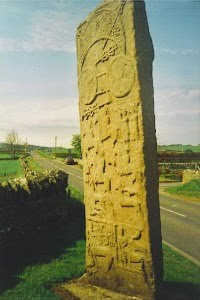
Aberlemno standing stoneLast week, I was honored to receive several visits from Taleworlds, a games-related forum hosted by a Turkish software company.

The topic there was "Why did Rome fail to conquer the Picts?" An interesting question, which continued: "Why did they fail while the Scots from Ireland succeeded?" (The questioner reminded us that "the Picts were a loose group of tribes while the Romans were a powerful empire".)

In amongst the robust repartee (which is common on most online forums), there was some inevitable misinformation. For example, in response to the observation that "Erm, Rome did conquer Scotland", referring to the Agricolan campaigns of AD 79-84, came the put-down: "there is debate over the legitimacy of Agricola's claims, though. Some believe it to be propaganda". Some probably do, but not generally those who have studied the subject.

Equally, there were some interesting observations, such as: "the Picts did not have enough trinkets, good land, gold, badassery to be worth it", and "It was too far, too full of smelly, hairy men, too little gold and, in general, they couldn't be bothered". All quite understandable opinions, if based on nothing more than gut reaction.

How Did Rome Conquer?

Along the way, I was struck by the following perceptive contribution:

  An area needs a certain amount of development before it can be forced into an empire. You need towns, significant trade in bulk necessities like grain, etc. If all you've got is a bunch of hundreds of mostly self-sufficient villages and farmsteads, then you can march an army in and march an army out without really making much of an impact. You can burn and loot a bit, but there's not enough agricultural surplus to support a big garrison, and even if you do set up big forts in the valleys controlling the major rivers and fords, no one cares, because they're not dependent on trade anyway.
  The way that places like Scotland and Wales were historically conquered was by settlement -- some other Germanic or Celtic group invaded, settled in the villages, intermarried with the existing tribes, and became the new tribal overlords. If you try that with professional soldiers, they will no longer be professional soldiers. An invading army might be able to change the demography or the language of such areas, but can't make them answer to an imperial or provincial capital.
Interesting ideas, which Roman scholars would do well to take on board. But more relevant, perhaps, to the wider geographical question, Why Did the Romans Fail to Conquer Scotland?, than to the specific query posed by the Taleworlds questioner.

Why Didn't the Romans Conquer the Picts?

The problem with this question is that it lacks historical perspective. Which Romans are we talking about? And did they try to conquer the Picts?

I have mentioned the problem of the Picts before, here, here, and here. But perhaps it's worth repeating the main points, for those readers who are not already sick of them.

Which Romans are we talking about? In the context of the Picts, we have stepped forward into the fourth century AD. Many would agree that, by then, the Roman army had passed its prime. But even if we cling to ideas of Roman invincibility, the army that rode north from York with Constantius Chlorus in AD 305 was a very different creature from the one that had crushed the Caledonian tribes at Mons Graupius in AD 84.

Did they try to conquer the Picts? There is every indication that, by the fourth century, Rome had grown accustomed to a British province that stopped at Hadrian's Wall. Septimius Severus may have dreamed of extending Rome's dominions in Britain in AD 210, but throughout the next hundred years, no other emperor had shared his vision. Constantius Chlorus' expedition bears all the hallmarks of a punitive raid, designed to show the flag to Rome's new, aggressive neighbours. It seems to have worked. A whole generation passed before the next recorded trouble in winter AD 342/3. And almost another before the campaigns of the 360s. And another before the campaign of AD 382. And almost another before that of AD 395.

Sadly, we lack details for any of these events. But it seems clear that these are not the actions of an aggressive empire attempting conquest. Rather, they suggest an exasperated empire slapping down an increasingly irritating neighbour.

Our lack of detailed evidence means that we view the Pictish picture through a glass darkly. But one thing is clear: the Romans did not "fail to conquer the Picts". Rather, they never attempted conquest. And in doing so, they failed to solve the problem of the Picts.

Monday, 17 January 2011

The Eagle Draws Nearer

Eagle movie posterThey're ramping up the publicity for the movie version of Rosemary Sutcliff's Eagle of the Ninth (which I blogged about here and here).

The movie will be released as "The Eagle", apparently to avoid confusion over the fate of Eagles I-VIII.

Last week, the Film Stage web site pointed to the featurette on Yahoo! Movies, claiming that The Eagle is "a movie I'm fairly certain I had never heard of until ten minutes ago". Shame on you, Film Stage! Some of us have been following the slowly unfolding saga since 2003.

The stand-out quote for this old emperor was Director Kevin Macdonald's claim, in the context of "Roman Britain, Celtic Britain", that "no-one knows what people who lived then were like". So it seems that the archaeologists may as well just pack their bags and forget it.

But he is right when he says that "it's a great, great story, and there aren't many great stories in the world which just take hold of your throat and lead you the entire way, and I think this is one of those great stories."

True. But is it going to be one of those great movies?

Tuesday, 4 January 2011

League of Extraordinary Gentlemen

ExplorersHappy New Year!

Late last year, I noticed that the Palestine Exploration Fund had put up a lot of photographs onto Flickr. Apparently, they have a collection of 40,000 images dating from 1850 right up to the present day; their Flickr photo-stream comprises 162 items, mostly from the 19th century.

One photograph (reproduced here) caught my eye. It shows "a group of explorers", the members of the Jerusalem Survey Team, relaxing on the evening of 15 August 1867. But this is truly a league of extraordinary gentlemen.

Introducing the Gentlemen

The fine figure in the centre, looking uncannily like Michael Palin from the Ripping Yarns television series, is the Reverend Dr Joseph Barclay (1831-1881), who became the Anglican Bishop of Jerusalem in 1879, two years before his untimely death. He had come to Jerusalem in 1861 as head of the London Society Mission, but resigned in 1870 in disgust at the organisation's poor standards of management. In 1867, when this photograph was taken, he was presumably still an enthusiastic representative of the Mission.

Seated on the right is Corporal H. Henry Phillips of the Royal Engineers, who is credited as the photographer. The Ordnance Survey of Jerusalem, which began in 1864 with the stated aim of improving the poor sanitation and water supply in the city, was carried out by volunteers from the Royal Engineers. It was in direct connection with this that the Palestine Exploration Fund was set up in 1865. Corporal Phillips recurs as Sergeant Phillips during the surveys of the 1870s.

The reclining figure in the foreground is Mr F. A. Eaton, M.A. (1836-1913), later Sir Fred Eaton, joint author of The Royal Academy and Its Members, 1768-1830 and sometime Secretary to the Royal Society.

Duffer Warren

Most interesting of all, though, is the figure seated at the left. This is Lieutenant Charles Warren R.E., later General Sir Charles Warren (1840-1927). After working for the Palestine Exploration Fund (1867-70), surveying and excavating in Jerusalem, he returned to Britain to further his career. In 1882, he was sent to Sinai to discover the fate of the Palmer expedition, and in 1886 became Chief Commissioner of the Metropolitan Police, during the time of the Jack the Ripper murders. In late 1899, aged almost 60, he took command in the Boer War, during which he bungled the relief of Ladysmith and was responsible for the massacre at Spion Kop. His incompetence was rewarded with promotion to Colonel-Commandant of the Royal Engineers.

What amazing stories are concealed in the peace and tranquility of this photograph.

The photo can be found at: http://www.flickr.com/photos/palestineexplorationfund/5226247909/

Monday, 6 December 2010

No Romans in China

The Lost Ninth Legion has been a recurring theme on this blog since 2007 (revisited in 2008 and 2009). And, with the new Eagle movie about to hit the big screen, there will no doubt be further revisiting.

But, from all of my previous posts, one which I never imagined revisiting was last year's Rome and China offering. But it seems that the theme of Romans in China is, again, in the headlines.

Daily Mail's picture

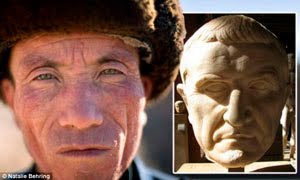
Chinese villagers 'descended from Roman soldiers'

This was the headline trumpeted on 23 November by no less an authority than The Daily Telegraph. Tests apparently showing 56% Caucasian DNA amongst the inhabitants of the Chinese village of Liqian, coupled with the fact that "many of the villagers have blue or green eyes, long noses and even fair hair", was enough to start the speculation that these people were "descended from the lost legion". (Don't panic -- it's not the Lost Ninth Legion, but a different one.)

The story was quickly picked up by the other newspapers (e.g. The Daily Mail) and, naturally, the bizarre theory of the village's Roman origins popped up. This was the brainchild of the late Homer H. Dubs in 1957 (in a book and article entitled A Roman City in Ancient China).

(I am surprised to see that I have not blogged on this before. It is a fascinating lesson in misguided scholarship, but must wait for another occasion.)

But, now -- thank the Olympian Gods for Discover magazine! Sanity has been restored. In an article from 29 November entitled No Romans needed to explain Chinese blondes, genetics commentator Razib Khan explains that the neighbouring Uyghur population were a Turkic ethnic group with a physical European appearance. It is quite likely that the Han Chinese, expanding their influence to the north-west, came into contact with these people. It's far more likely, at any rate, than Homer Dubs' theory of a colony of Romans!

Well, there goes another plank in the "Romans in China" theory. But, like our Lost Ninth Legion, I suspect that this story will run and run.

Monday, 22 November 2010

Roman twitter

Tullie House iTweetus imageThe Romans are tweeting. Whatever next?

Apparently, Roman experts at Tullie House Museum in Carlisle have decided to post a daily message on Twitter, purporting to be one of the "thousands of Roman soldiers marching in to occupy Cumbria in the winter of 72/73 AD". They call it iTweetus.

What a marvellous idea. The name "is a play on words of the celebrated novel I, Claudius, written in the form of an autobiography of a real Roman Emperor, Claudius I". (It's a sad day when we have to have I, Claudius explained to us. And only people who don't need it explained would know that the emperor Claudius was technically "the first", since a second, more obscure emperor of the same name reigned over 200 years later.)

Unfortunately, iTweetus doesn't have the wit and wisdom of Robert Graves, which is surely needed to pull off a stunt like this.

Daily Diary of a Roman Soldier

Our Roman soldier, Marcus Julius Latinus, takes his name from a fragment of a writing tablet dredged from a latrine deposit at Roman Carlisle. Probably dumped there in around AD 103/5, when the first fort was demolished, it must have lain in the latrine for quite some time if it was delivered to iTweetus "in the winter of 72/73 AD". He really ought to have taken better care of his correspondence.

The whole enterprise is evidently intended to be educational: the kind of thing that our American friends call info-tainment. But, as the daily diary of a Roman soldier, it comes across as rather a contrivance. The museum's Keeper of Archaeology, Tim Padley, evidently hopes that primary school children will follow iTweetus (Westmorland Gazette report). Hence the casual mention of Marcus' height ("At 5ft10” I used to tower over my siblings, in the Roman army my height is standard. I strain to see past others in to the distance") or his age ("At 26, I am not a stranger to the daily routine of a Roman Legionary, being stationed in Deva in the second legion for the past two years"). But who would note such banalities in their wartime diary?

If the exercise is an educational one, quite apart from avoiding factual error ("Our legion, named ‘Aditrix Pia Fidelis’ is full of good, brave men." It was actually called the Second Adiutrix legion), this old emperor wishes that the Tullie House "Roman experts" would spend a little more time on their grammar (Note: a comma is not a conjunction). And it would be nice if they placed "AD" in its grammatically correct position, before the numeral ("I am Marcus Julius Latinus, a Roman soldier marching on Northern Britannia by order of Emperor Vespasian in the winter of 72AD")

In particular, this old emperor hopes that none of the Cumbrian school children are sharp enough to realise that their Roman friend is using a dating system that wasn't devised until the Sixth Century!

Monday, 1 November 2010

Three-million-dollar Helmet

Crosby Garrett HelmetYou know that a story is important when the folks at National Geographic pick it up.

And so, this old emperor comes, somewhat belatedly, to the sorry tale of the Crosby Garrett helmet. By now, you've probably read all about it elsewhere.

And if there were any justice in the land, you would be able to view it, right now, in Tullie House Museum.

But it seems that there isn't. And you can't. But, if nothing else, the whole sorry affair should prompt English law-makers to revise their Treasure Act (1996), which considers only precious gold and silver to be worthy of note, and failed to protect this exquisite helmet because it is made of base metal.

Some press coverage:


Sunday, 10 October 2010

Romans in Germany

Germania BookThis old emperor rarely ventures outside of Rome, and usually confines himself to the new lingua franca of English. But he couldn't ignore the publication of an exciting new study by German publisher WBG, which traces Roman knowledge of deepest Germany.

It is well known that the Roman advance stalled on the Rhine, more or less. After a couple of punitive expeditions had reached as far as the River Elbe, the Roman frontier settled down along the line now known as the Obergermanisch-Raetischer Limes, which runs through the modern west German states of North Rhine-Westphalia, Hesse, Baden-Württemberg and Bavaria. It is generally agreed that the Romans had few dealings farther east.

Ptolemy's map

But the second century AD Geography of Ptolemy contains lists of placenames purporting to exist in Roman-era Germany. These have never raised much interest in the English-speaking world, which has been more intrigued by Ptolemy's Scottish placenames. So the new book promises to renew much overdue interest.

German magazine Der Spiegel has hailed the new book as the Google Earth of Antiquity! "Now a team of researchers have cracked the code, revealing that half of Germany's cities are 1,000 years older than previously thought." They may be a little premature in their claims -- only the book reviews will reveal how successful the authors have been in assigning Ptolemy's placenames to actual settlements.

WBG Article here.

Wednesday, 1 September 2010

Why History should not be written by Journalists

Last week, the UK newspapers were full of an amazing new revelation. The Romans wore socks! The newsmen arrived at this earth-shattering conclusion via a convoluted path -- they were supposed to be reporting the excavation of an exciting Roman industrial complex -- and chose to spin their revelation as a new take on the tired stereotype of the "socks and sandals" fashion crime.

There are a number of points that should have caused any reasonably well-educated newspaper editor to rein in his over-enthusiastic minions. After all, the news was the discovery of Roman industrial activity near the site of a known fort at Healam Bridge, North Yorkshire. The opportunity could have been taken to inform the public that many forts are known to have had such manufacturing activity located nearby.

Instead, such venerable newssheets as The Daily Telegraph, The Guardian, The Daily Mail, and The Independent chose to emphasize the fact that "rust on a nail from a Roman sandal appears to contain fibres". (How do we know the nail was from a sandal and not a shoe? How do we know the fibres were from inside the putative sandal? What kind of fibres were they, anyway?)

Of course, newspapers are in the business of selling copies, not (necessarily) crafting a well-balanced report. The Independent mis-informs us that this "latest evidence corroborates the socks and sandal theory which first emerged when a Roman copper razor handle was recovered from the Tees near Darlington". No, it was well-known long before that. The Telegraph mistakenly assumes that the find shows "that legionnaires wore socks with sandals". No, legionnaires belong in Algeria, not in a North Yorkshire fort. Best of all, The Guardian's offering shamelessly centers on a reference to the Lost Ninth Legion and their (supposed) military outpost in Yorkshire. But pride of place must be shared with The Mail, speculatively describing the unexcavated Healam Bridge as "ruins which may once have been home to the famous Roman Ninth Hispanic Legion".

It all goes to show that History should not be written by journalists.

Monday, 23 August 2010

Why History should only be written by Historians

History is written by the victors. To anyone who finds this an unpalatable truth, I have one piece of advice: get over it. The history of Roman Britain will always be the history of the Romans in Britain. Archaeology can show us vignettes from the lives of ancient Britons, but it cannot give us a History of the Ancient Britons. All we can hope to do is to observe how the history of the Romans in Britain touched the lives of the native population.

One individual who has not realised this truth, or who has chosen to ignore it, is the owner of the Roman Scotland web site, one Euan Lindsay by name. I'm sure I have been here before, refuting false or misguided statements. A favorite topic of his seems to be how the academic establishment has conspired to falsify Romano-British history, particularly where the "Lost Roman Legion" is concerned. I believe that it is always bad form to begin with an agenda, but let us leave that aside.

Now Mr Lindsay is entitled to his own opinion. Indeed, he is positively encouraged to voice that opinion, as long as he sticks to the Rules of Historical Enquiry, because history is an academic discipline like any other. A physicist is not permitted to invent the results of falsified experiments. A statistician cannot arbitrarily skew the results of a survey to satisfy some personal belief. A mathematician cannot assume that a theorem is true without demonstrating the proof. Likewise, the historian is not allowed to make stuff up.

Mr Lindsay, unfortunately, is guilty of making stuff up. This simply will not do. He begins well enough, by listing the sources of evidence that he intends to utilise in tracking down the Lost Legion: namely,

  1. "the primary written sources from antiquity";
  2. "the archaeological source in the shape of marching camp remains" (I presume he does not literally mean the "shape" of the camps);
  3. "the tribes known to have been in conflict with Rome" (and here he begins to stray from "evidence" into "interpretation", if not wishful thinking); and
  4. "casting a canny eye over the landscapes that these factors point towards" (scientific analysis has now left the room)
His argument goes rapidly downhill, because he has not followed the Rules of Historical Enquiry. In category (1), his "ancient sound-bites" (a truly toe-curling phrase in this old emperor's opinion) are very woolly indeed. He claims that "when taken with the archaeological body of evidence of destruction in southern Scotland and along the Stanegate in 105 AD ..." (er, exactly what evidence is this?) "... it assists in painting a tantalising picture of the troubled years immediately preceding Hadrian’s ascension to power in 117 AD". Tantalising is, of course, the wrong word; vague, is more accurate.

Category (2), "the fragmentary remains of the once-mighty chains of camps which marked the progress of many Roman armies on campaign in Scotland" (once mighty? shudder), leads precisely nowhere. So it remains unclear how this can be "an incredibly fruitful – if speculative - line of enquiry".

Category (3), where Lindsay hopes to "glean a fair understanding of which tribes were frequently at odds with Rome", actually relies upon category (2), allegedly permitting us "to focus on marching camps which sit in the problematic lands of those notably intractable tribes". Which notably intractable tribes? On the one hand, Lindsay is arguing that marching camp = intractable tribe, but on the other hand, intractable tribe = marching camp; we could dance around this circle all day.

Finally, in category (4), "it is absolutely imperative that a quest like this is undertaken out in the countryside" ... where the truth will leap up and slap us in the face? What about all that careful sifting of (1) literary evidence, however tantalising, and (2) archaeological evidence, allegedly incredibly fruitful, and (3) tribal, er, evidence ...?

Any case based on these vague factors would (and should) be laughed out of Historical court. There's a reason why History should only be written by Historians.